Annunciation
by Leonardo da Vinci
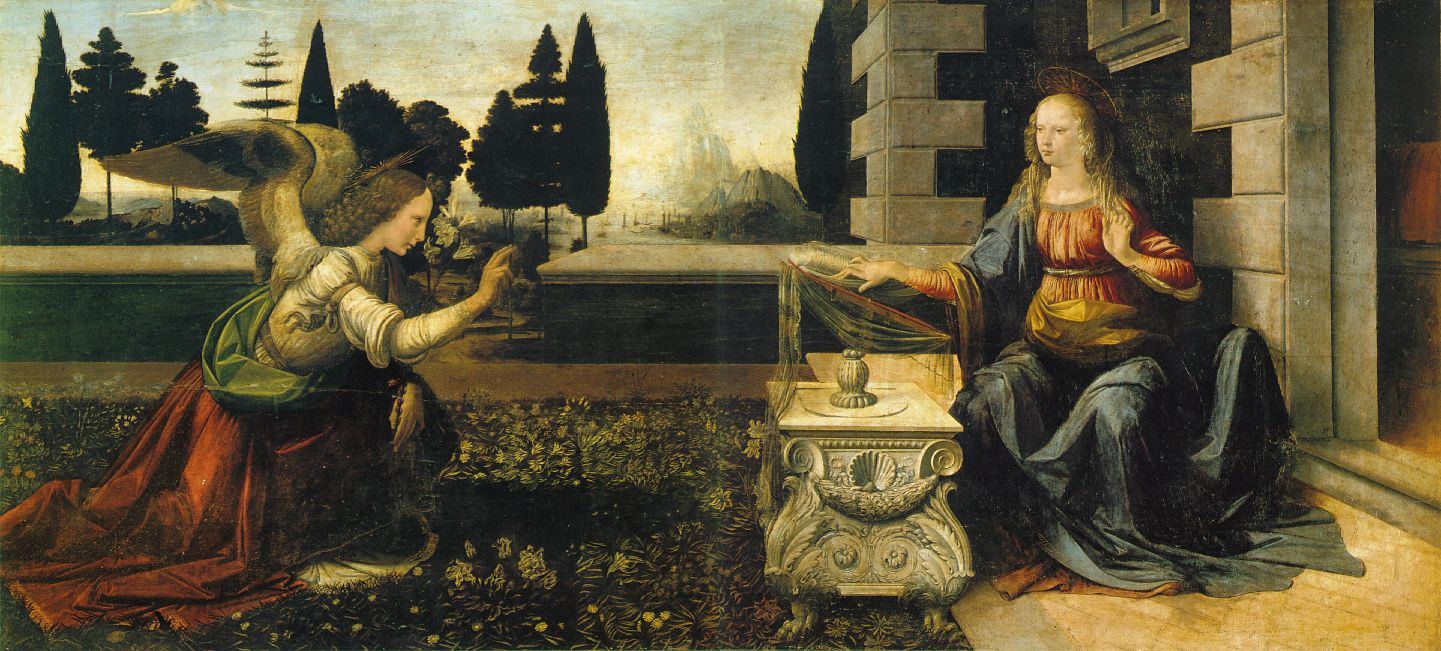
The Annunciation - Galleria degli Uffizi, Florence
Attribution Analysis
The painting was attributed to Ghirlandaio upon arrival at the Uffizi, then disputed by Giovanni Morelli (who assigned it to Ridolfo Ghirlandaio). Discovery of a preparatory drawing for the angel's sleeve (Study of a Sleeve, 1473, Christ Church Picture Gallery, Oxford) definitively confirmed Leonardo's authorship. The marble lectern derives directly from Verrocchio's tomb of Piero and Giovanni de' Medici in San Lorenzo, confirming the workshop connection. Current consensus: primarily Leonardo's work, painted as a youthful piece c. 1472–1476, with possible Verrocchio design contributions to the lectern.
Subject And Iconography
The Archangel Gabriel kneels before the Virgin Mary in an open garden (hortus conclusus) before a Renaissance palace. Gabriel holds a Madonna lily (symbol of purity and Florence); Mary sits at an ornate lectern behind an open book containing Latin abbreviations without meaningful sequence — possibly representing mystical meditation. Behind a low wall, the background features a winding river, mountains, distant harbor, and atmospheric haze. Leonardo's innovation was radical: he placed the Annunciation outdoors (traditionally an interior scene) and gave the angel a physical shadow on the grass, establishing corporeal presence.
Mysteries And Hidden Elements
The extended arm anomaly: Mary's right arm appears disproportionately long when viewed head-on. This is explained as intentional anamorphic distortion — the painting was designed for lateral viewing from the right and below, consistent with placement over a side altar. From this angle, the proportions and architectural keystones align correctly. This reflects Leonardo's early optical research documented in his notebooks. The angel's wings were lengthened by a later, unknown artist from their original bird-like proportions.
Infrared reflectography revealed an extensive underdrawing in liquid brush medium with bold schematic lines, geometric perspective construction aids, and some changes between underdrawing and final paint — documenting Leonardo's iterative creative process.
Research & Analysis
The painting was attributed to Ghirlandaio upon arrival at the Uffizi, then disputed by Giovanni Morelli (who assigned it to Ridolfo Ghirlandaio). Discovery of a preparatory drawing for the angel's sleeve (Study of a Sleeve, 1473, Christ Church Picture Gallery, Oxford) definitively confirmed Leonardo's authorship. The marble lectern derives directly from Verrocchio's tomb of Piero and Giovanni de' Medici in San Lorenzo, confirming the workshop connection. Current consensus: primarily Leonardo's work, painted as a youthful piece c. 1472–1476, with possible Verrocchio design contributions to the lectern.
The Archangel Gabriel kneels before the Virgin Mary in an open garden (hortus conclusus) before a Renaissance palace. Gabriel holds a Madonna lily (symbol of purity and Florence); Mary sits at an ornate lectern behind an open book containing Latin abbreviations without meaningful sequence — possibly representing mystical meditation. Behind a low wall, the background features a winding river, mountains, distant harbor, and atmospheric haze. Leonardo's innovation was radical: he placed the Annunciation outdoors (traditionally an interior scene) and gave the angel a physical shadow on the grass, establishing corporeal presence.