The Last Supper
Il Cenacolo / L'Ultima Cena
by Leonardo da Vinci
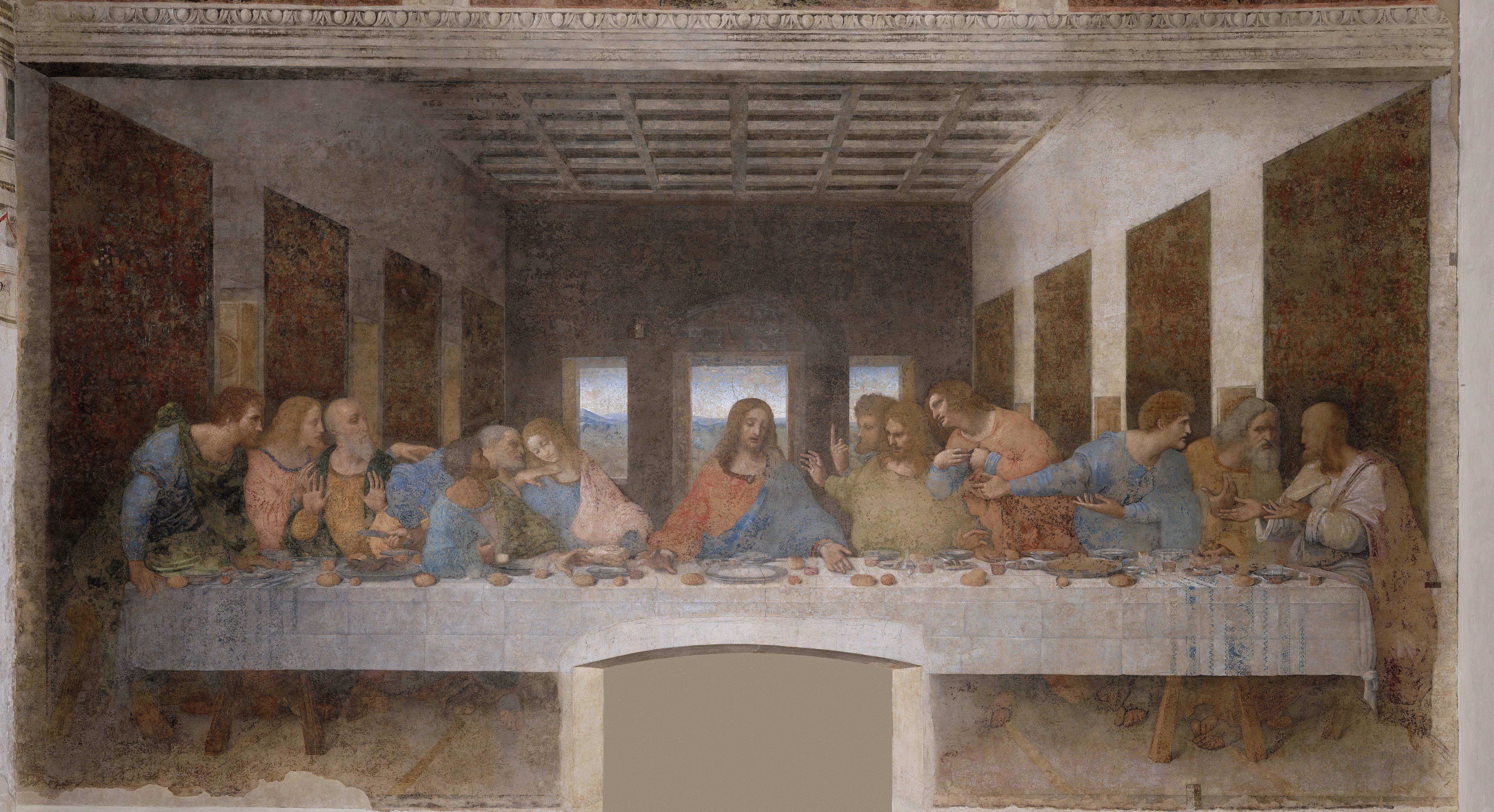
The Last Supper (Il Cenacolo) - Santa Maria delle Grazie, Milan
The Moment That Changed Art
Leonardo's Last Supper shattered every convention of the cenacolo tradition. He placed Judas among the apostles instead of isolating him across the table. He eliminated halos entirely, using backlighting through three windows to distinguish Christ. He organized twelve figures into four dynamic groups of three — each expressing individualized psychological responses he called moti dell'anima, "movements of the soul." The result was the most psychologically complex painting the world had ever seen.
A Theological Synthesis
Art historian Leo Steinberg argued the painting depicts not a single frozen instant but two simultaneous moments: Christ's announcement "One of you will betray me" and the institution of the Eucharist — his left hand reaching toward bread, his right toward wine. Dominican friars eating below understood themselves as seated at the opposite side of the sacred table, their daily meal transformed into participation in the Eucharistic sacrifice.
A Masterpiece Dying From Birth
In true fresco, pigments bond chemically into the wall. Leonardo's paint merely sat on a sealed dry surface. Deterioration was noticed by 1517. By 1556 Vasari called it "a muddle of blots." A doorway was cut through Christ's feet in 1652. Napoleon's troops used it as a stable. An RAF bomb in 1943 collapsed the refectory around it. The 22-year Brambilla restoration (1978–1999) consumed 38,000 hours and $8 million — revealing what Leonardo intended beneath centuries of damage.
Explore The Last Supper
Dive deep into every aspect of Leonardo's revolutionary masterwork — from the theological foundations to the chemistry of paint.
The Twelve Apostles
Every gesture, every face — decode the psychological drama of each figure and the four groups of three.
Theology & Scripture
Four Gospels, one painting — how Leonardo synthesized betrayal, Eucharist, and Dominican doctrine.
Technique & Materials
Ultramarine, vermilion, kermes lake — the pigments, binding medium, and experimental chemistry.
Conservation & Restoration
500 years of damage and seven restorations — from 1517 decay to the controversial 22-year Brambilla campaign.
Composition & Perspective
The vanishing point, Pythagorean ratios, Trinitarian geometry, and the illusion of infinite space.
Symbolism & Hidden Details
The overturned salt, the eel with oranges, the millefleurs cloth — every object tells a story.
Preparatory Drawings
From Windsor Castle to Venice — trace Leonardo's evolution from conventional sketch to radical vision.
Before Leonardo
The cenacolo tradition he dismantled — from Giotto and Castagno to Ghirlandaio and Perugino.
Historical Context
Sforza's ambition, the Italian Wars, Beatrice d'Este's death, and the fall of Milan.
Visiting Today
Airlock chambers, 15-minute slots, climate control — everything you need to plan your visit.
Digital Afterlife
16-billion-pixel scans, 8K VR experiences, and the Giampietrino copy that revealed lost details.
Legacy & Cultural Influence
From Warhol's 100+ works to The Da Vinci Code — how the painting shapes modern culture.
The Paradox That Defines the Masterpiece
Leonardo's Last Supper exists in a state of creative tension between ambition and fragility that mirrors its theological content — the divine expressed through the perishable. The very qualities that made it revolutionary — psychological specificity, chromatic subtlety, atmospheric depth — depended on a technique that could not survive its substrate. What remains is estimated at somewhere between 20% and 50% of Leonardo's original brushwork, overlaid with centuries of damage, intervention, and scholarly debate about what constitutes "the real painting."
Yet the work's power endures precisely because its innovations were conceptual as much as material. The grouping of apostles in psychologically interconnected triads, the synthesis of betrayal and Eucharist into a single suspended moment, the use of perspective to collapse the boundary between sacred scene and lived space — these ideas survived even when the paint did not. Every subsequent Last Supper depiction exists in dialogue with Leonardo's vision.